
Contents
- Why is an experienced SAP hire different?
- What should a completed search prove?
- What sits behind the map?
- Stage 1. Why does nothing start until the brief is done properly?
- Stage 2. Why does a search start with a map rather than with candidates?
- Stage 3. Why approach people anonymously?
- Stage 4. How do you tell two identical SAP resumes apart?
- Stage 5. What happens on the weekly call?
- Stage 6. Where are searches quietly lost?
- Stage 7. What happens after the offer is signed?
- How long does it take?
- What does the methodology ask of you?
The Initiate 7-Stage Mapped Search Methodology
Last updated: September 2026
Summary
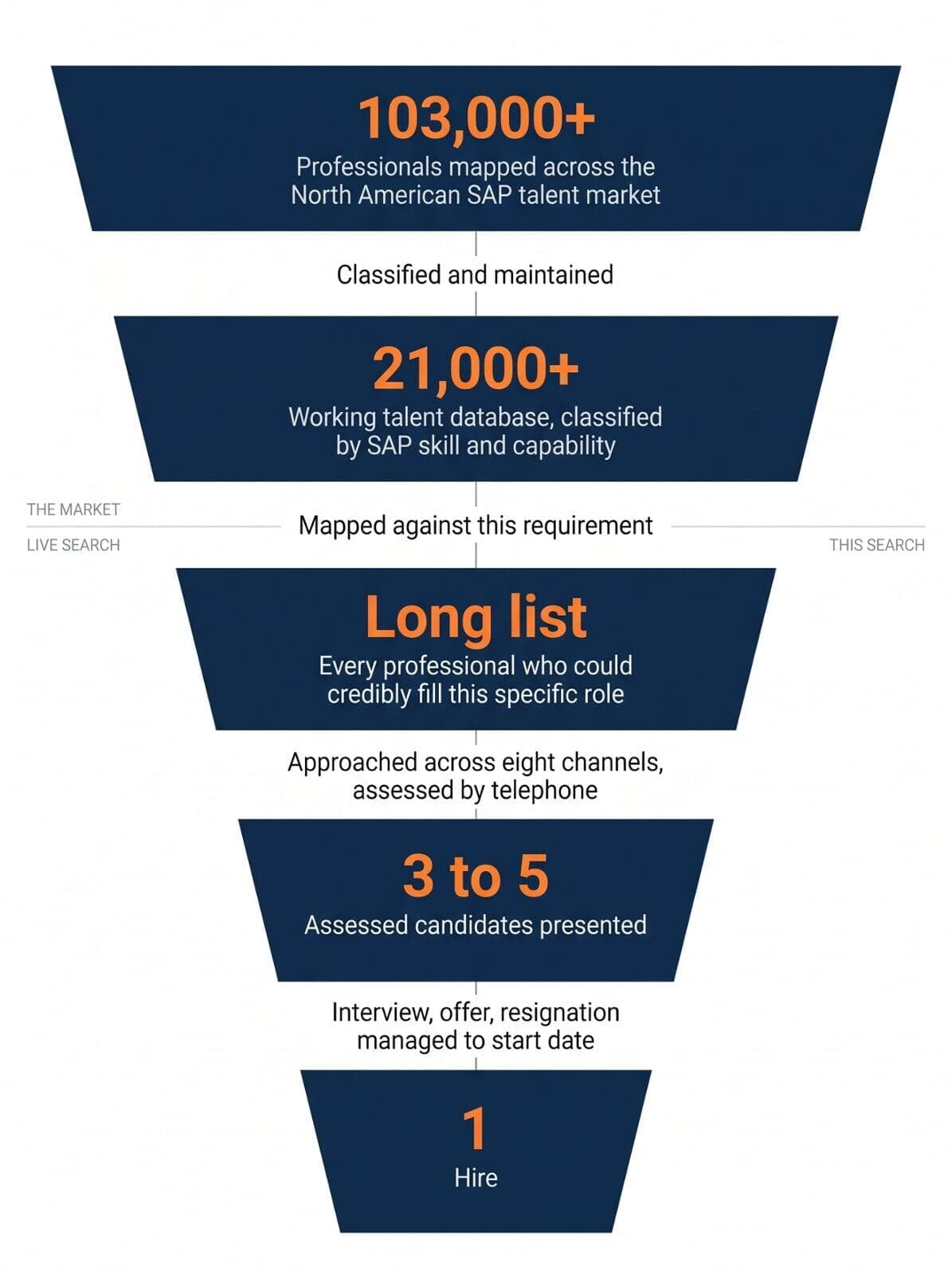
Experienced SAP hires are not made from a shortlist of people who applied. They are made from a map of everyone who could do the job, a structured approach to every one of them, and an honest assessment of who would actually move.
This document sets out how that runs, in seven stages, from the first briefing call to the point where a new hire has settled. It covers permanent SAP appointments in the United States. Contract and interim engagements follow a separate, compressed process.
Why is an experienced SAP hire different?
The scarcity in this market is specific, not general. An architect who has delivered a live ECC-to-S/4HANA conversion end to end looks identical on paper to a hundred people who never have.
Specialist SAP roles routinely take more than ninety days to fill, against roughly forty-four days for general IT. That gap is not a question of sourcing volume. It is a question of knowing which programs delivered, who was on them, and how to reach those people before a competitor does.
What should a completed search prove?
Most searches end with a shortlist. A shortlist tells you who was available, who was visible, and who happened to respond. It tells you nothing about who exists.
When this search closes, every professional in the United States who could credibly have filled the role has been approached, has understood what was on offer, and has made a decision.
Nobody is missing from your process because they never heard about it. Not because a job posting went unseen. Not because a platform limited who could be contacted. Not because a keyword failed to match the way they described their own experience.
Everyone who is not in front of you made a choice not to be. That is a different proposition from a shortlist, and it is the standard the seven stages exist to meet.
What sits behind the map?
A structured intelligence layer across the North American SAP talent market, rather than an accumulation of candidate records.
| Measure | Figure |
|---|---|
| Professionals mapped across the North American SAP talent market | 103,000+ |
| Working talent database, drawn from that map | 21,000+ |
| Working database classified by SAP skill and capability | 97% |
| Employers represented across the database | 8,100+ |
Figures accurate as at Q4 2026.
Two tiers, and why the distinction matters
The 103,000 are the search universe: the mapped population of the North American SAP market, held and maintained independently of any platform. That is the boundary of what exists.
The 21,000 are the working database, drawn from that universe as the tier worth interacting with. These are the professionals whose capability is classified, whose history is recorded, and with whom a relationship exists or can be opened quickly.
A search runs against both. The universe establishes who could conceivably fit. The working database establishes who is already known, already assessed, and already reachable. Neither number is useful without the other. A map with no relationships produces names. Relationships with no map produce a small pool mistaken for a market.
Why the employer figure carries the most weight
Every professional in the map is associated with an organization. For employees that is their employer. For independent contractors it is the client they deliver for. That association is the point of the mapping exercise, because the organization carries attributes the individual's profile frequently does not.
- Location. Where the work is actually done, rather than where a profile says someone lives.
- Industry. Manufacturing, life sciences, utilities, public sector, and the regulatory conditions that come with each.
- Technology footprint. Which SAP landscape is in place, which deployment model, and what stage of transformation the organization has reached.
Those attributes describe the people. Someone delivering inside a life sciences business running a validated S/4HANA landscape has GxP exposure whether or not their profile says so. Someone inside a utility running IS-U has utilities experience by definition.
That is what allows a search to be built from programs and organizations rather than from job titles, and it is why 8,100 represented employers matters as much as the headcount figures above it.
Stage 1. Why does nothing start until the brief is done properly?
Nothing starts until an hour has been spent on the requirement.
A job specification describes the skills. It does not explain why a person who is already employed, already paid well, and already trusted by their current employer would leave to do this instead. That is the actual problem to be solved, and it cannot be solved from a document.
What the call covers
- Who you are as a business. How you see yourselves, how the market sees you, and who you compete with for people as well as for revenue.
- The real requirement behind the specification. What this person owns, where they sit in the team, and what the role becomes after go-live.
- The hiring trigger. What is happening right now because the seat is empty: a contractor covering it, a manager absorbing the work, tasks distributed across the team, or the work not being done at all. Each of those carries a cost, and none is sustainable indefinitely.
- How the opportunity is positioned to the market. What makes it worth a move.
- The candidate experience you want associated with your name.
What you take away from it
- Clarity on your own requirement. Most briefs arrive as a specification and end as a sharper definition of what is actually needed. That happens through the structured questions, not despite them.
- Market intelligence: where this profile realistically exists, what it costs, and what is reasonable to expect against what is not. Including the answer to whether one person can cover everything on the list. Often they cannot, and week one is the right time to know it.
- An early view of the search universe. Which organizations this person comes from, and whether that is realistic.
- A timeline built backwards from reality. Two weeks minimum on notice, unless someone is immediately available. Then search time, presentation, deliberation, interviews, feedback, decision.
Why the brief matters beyond the search
A role taken to market without this conversation gets represented by someone working from assumption. The pitch reflects how the recruiter sees the opportunity, not how you see it, and the candidate forms a view of your organization on that basis. That view does not expire when the search closes. It surfaces again six months or six years later, when the same person is approached about a different role.
The candidate market is a stakeholder market. It holds a memory, it talks to itself, and in SAP it is small enough that it does so accurately. Searches inherited part-way through frequently reveal the same pattern: professionals who have already been approached about the role, who already have a view of the employer, and who have already declined. The available universe had narrowed before the search began.
This stage is the preparation, and it ends with the requirement in the hands of someone equipped to own it.
Stage 2. Why does a search start with a map rather than with candidates?
The search does not start with candidates. It starts with a map.
What gets mapped
- Direct competitors, and the organizations running SAP programs of comparable scale and complexity.
- Which companies this profile realistically comes from, defined by program type rather than by sector.
- The named individuals inside those organizations, and where they sit today.
- Who has worked alongside this profile before and can introduce, refer or vouch.
That becomes the search universe. Everyone who could conceivably fit is in it. From there the list narrows on evidence rather than on availability.
Why keyword search fails in this market
SAP terminology is fragmented and inconsistent, and it defeats keyword matching more comprehensively than almost any other enterprise discipline.
Finance alone appears as FI, CO, FICO, Finance, Central Finance and Treasury, depending on who wrote the profile and when. HR appears as HCM, HXM, SuccessFactors and Human Capital. The word SuccessFactors also appears in profiles describing the success factors of someone's career, which has nothing to do with the platform at all.
The result is noise in both directions. Relevant people are missed because they described the same work in different language, and irrelevant people fill the results because a term matched by accident. A search that should take two weeks takes eight.
SAP is also too broad to be treated as a single discipline. Every function of the business runs a different part of the platform, and each carries its own specialist population. There are niches inside the niche, and knowing which one a requirement actually sits in is the difference between a shortlist and a list.
Why platform search surfaces the wrong people
On a public platform, visibility is not a proxy for capability. The profiles that rank are the ones written at length, updated frequently and optimized for discovery. The professionals running critical SAP programs are generally the ones with the least time and the least incentive to do any of that.
Many reduce their visibility deliberately. Profiles are made private, contact details removed, connection and messaging restricted. Experienced SAP professionals with scarce skills are among the most heavily approached people in enterprise technology, and a significant number respond by becoming harder to find.
Those people are still reachable. They are reached because a relationship already exists, or through a referral from someone who knows them. Referrals require the relationships to have been built before they are needed, and they require asking well. Most are never obtained because the question is never asked, or is asked in a way that makes it easy to decline.
What sits behind the map
Fourteen years of SAP-specialist search in the United States. The market is already mapped, the classification already applied, and the relationships already established. Each search enriches the universe against its own specific requirement, but it does not begin from zero and it does not begin on a platform whose access terms are set by someone else.
A rented audience can be restricted, re-priced or withdrawn. This market picture is held independently and maintained continuously.
What you see
The map. Named organizations, coverage achieved, and gaps identified. On a retained or engaged basis that extends to the pipeline itself: how many people exist against this requirement, where they sit, and what the market genuinely holds.
Stage 3. Why approach people anonymously?
Every target profile is approached. Not advertised to. Approached.
How it runs
The long list narrows to the profiles that fit the brief. Each enters a structured outreach sequence across email, LinkedIn connection, LinkedIn message, InMail, telephone, voicemail, SMS, and requests for warm introduction through mutual contacts.
The sequence is deliberate and it is human. It is not an automated campaign and it does not read like one.
Why anonymity protects the candidate
Experienced professionals rarely approach a competitor directly, and the reason is practical. Direct contact triggers informal reference checking almost immediately. One executive calls a former colleague to ask what someone was like to work with, the question gets repeated, and within days the individual is known to be exploring the market. The risk of that reaching a current employer is real, and it is why the strongest people stay still rather than move badly.
A confidential conversation with a specialist intermediary removes that exposure. The individual can assess an opportunity properly, be positioned accurately, and decline without anyone knowing they considered it. That protection is the single thing candidates in this market are most consistently grateful for, and it is why they take the call at all.
Why anonymity protects the client
Attach a company name to a first approach and the recipient researches it before they have understood the opportunity. They find a post on a forum, a comment from a former employee, an old colleague they did not get along with, or an impression formed five years ago that was never accurate. They decline on that basis, and nobody has had the chance to present the role, correct the record, or answer the objection.
Anonymous approach keeps the conversation live long enough for the opportunity to be understood. Identity is released once both parties are in a proper telephone discussion, where objections can be raised and addressed rather than acted on silently.
Why this replaces advertising
Advertised SAP roles at this level generate volume rather than quality. Click-to-apply produces applications from people without the relevant capability and, frequently, without work eligibility. The time absorbed in filtering that volume is time not spent approaching the people who can actually do the job, and the people who can do the job are not reading job boards.
Direct approach inverts that. Every relevant professional is contacted across multiple channels, which produces a specific and defensible outcome.
Anyone not in your process chose not to be. They are not absent because the role never reached them, because they missed a post, or because a platform limited who could be contacted. They were approached, they understood what was on offer, and they decided.
That is the claim the whole methodology is built to support, and it is the one worth testing. Ask any search partner to name who they approached and what came back. The map, the coverage reporting and the decline reasons are the evidence, and they are produced as a matter of course rather than on request.
In a market this thin, that distinction is the difference between a search that covered the market and a search that covered whoever happened to be visible.
What you see
Coverage reporting against the map. Who was approached, through which channels, who engaged, and who declined with the reason given.
Stage 4. How do you tell two identical SAP resumes apart?
Every candidate presented has been spoken to properly. Not screened against a checklist. Talked to.
Capability, assessed against the program rather than the resume
An SAP resume lists the modules someone has touched. It does not establish whether they have done the thing you are hiring them to do. Full lifecycle implementation is the clearest example: the phrase appears on thousands of profiles and means something different on almost every one. The work is in establishing which part of that lifecycle the individual actually owned, what the systems integrator owned, and what the internal team owned.
The questions that separate two profiles that look identical:
- Greenfield, brownfield or selective data transition. Which, and how many times. The skills are not interchangeable and neither are the people.
- Conversion against implementation. A live ECC-to-S/4HANA conversion delivered end to end is a different experience from a new implementation, and a very different experience from an upgrade. The scarcest profile in this market is the architect with a live conversion behind them.
- Where they sat. Client side, systems integrator side, or contractor. Whether they held design authority or attended the meetings where it was held.
- What they owned end to end. Not the phase they were present for. The scope they were accountable for, from blueprint through to hypercare.
- Deployment model. RISE, private cloud, public cloud or on-premise. The commercial and technical constraints differ enough to matter.
- Clean core discipline. How custom code and extensions were handled. Side-by-side extension on BTP against modification in the core. This reveals more about judgment than any certification.
- Integration reality. BTP, Integration Suite, core-to-edge integration, and what broke.
- Data. Migration, master data management, data quality, and whether they have lived through a cutover that went badly because the data was not ready.
- Fit-gap experience. Whether they can run the analysis and then defend the decisions to a business that wants everything customized.
- Industry and regulatory exposure. GxP validation, IS-U, public sector, clearance status where relevant. These narrow a universe sharply and cannot be acquired after the fact.
- What went wrong. The most useful question in an SAP assessment. Anyone who has genuinely run a program carries a scar. Three flawless go-lives usually describes proximity rather than ownership.
The method is to follow the thread. A claim on a resume leads to a question about what that claim necessarily implies, and then to what the individual knows about the consequence. Capability is visible in how confidently that thread holds.
Motivation and circumstance
- Push. What is actually wrong where they are. Rarely what is said first.
- Pull. Where they want their career to go, and whether this role sits on that path or diverts from it. In this market that usually means design authority, greenfield scope, data and AI exposure, or an exit from a keep-the-lights-on AMS role.
- Circumstances. Home ownership, relocation appetite, travel tolerance, work eligibility, notice period, and on-site expectations measured against their actual situation.
- Compensation in detail. Base, bonus, equity, benefits and structure, compared honestly against what is on offer.
- Competing activity. What else is live in their process, and what else may land in the same week.
- Counteroffer exposure. Established here, at the start. Not discovered at resignation.
None of that emerges from a first conversation with a stranger. It emerges from a relationship and a degree of trust, which is what this stage exists to build.
The pitch is then built for the individual
References
Formal references are taken as the process requires them. Informal reference gathering runs alongside, through a network built across fourteen years in the same market. In SAP, the people who have worked on the same programs are rarely more than one connection apart.
What you receive
Three to five candidates per search, with capability evidence, motivation, circumstance and risk stated openly. Including the reservations. A candidate's hesitations are more useful to you than their enthusiasm, and they are easier to address in week two than in week ten.
Stage 5. What happens on the weekly call?
Fifteen to twenty minutes each week. It is short because it is prepared.
What the call covers
- Where the search sits against the map. Approached, engaged, declined, and the reasons given.
- What the market is returning. Real rates, real bands, real availability, drawn from live conversations rather than survey data.
- Profiles of interest and the emerging shortlist.
- Your feedback, and what it changes.
Recalibration is expected, not a failure
Where the evidence says the requirement is wrong, it is raised with the evidence attached. That includes the harder conversations: the band sits below what the profile commands, transformation scope is priced as an operational role, or the interview process itself is losing people. That is information worth having in week three. It is worth very little in week twelve.
Your reputation in the market
Every approach, every conversation and every decline is handled in your name, whether or not that name has been released yet.
Candidates who do not get the role still form a view of your organization, and they hold it. Professionals who interviewed somewhere and never received feedback decline to engage with that employer again, sometimes years later. People who have given up their time to prepare and attend expect an answer, and the absence of one is remembered accurately.
In a market where 8,100 employers are represented but the experienced population is measured in thousands, that memory compounds. Communication in both directions, positive and negative, is treated as an obligation of the search rather than a courtesy attached to it.
What the engagement model changes
A contingent search run across several agencies produces a different outcome. Speed of submission is rewarded over quality of assessment, nobody is resourced to map the market, and the intelligence is not generated because nobody is in a position to invest in generating it. The candidate experience degrades with it, which returns the cost to your employer brand.
Stage 6. Where are searches quietly lost?
The administration in this phase is where searches are quietly won and lost. It is consistently undervalued, and it is not a scheduling exercise.
Scheduling is a diagnostic
Taking a candidate's availability is also the point at which their state of mind is established before they walk into the room. What they have heard. What they assume. Who in their network holds an opinion about you, accurate or otherwise.
Those assumptions are either corrected directly or passed to the hiring manager as interview prompts: what to address, what to probe, where the reservations sit, what will move this person and what will lose them. A misconception surfaced before the interview can be answered in it. The same misconception surfaced afterwards has usually already done its work.
Debrief after every stage, both sides
From the candidate: where they felt strong, where they felt weak, what they responded to, and what they remain unsure about. Reservations surface early or they surface at offer, and early is survivable.
From you, on the weekly call: how the interview went from your side, what has changed, and how the requirement has moved now that you have met people.
Pace is part of the process
Every brief opens with a requirement to hire quickly. The process then meets its real constraint, which is usually internal. Resumes sit unreviewed, interview slots take a week to confirm, and decisions wait for a diary.
The scarce people do not wait. They are in other processes, and the employer who moves decisively takes them. An experienced hiring manager recognizes the right person when they meet them and acts on it. The instinct to hold out for a comparison set is reasonable in a deep market and expensive in this one.
Where your process is the constraint, that is raised directly. It is more useful than another shortlist.
Offer management
An offer is not extended without knowing what it is competing against: current compensation against the offer value, what else is live in their pipeline, and what else may land in the same week.
A verbal acceptance is not the end of the search. It is the point at which the highest-risk phase begins.
Stage 7. What happens after the offer is signed?
The offer is signed. The candidate now has to resign, and that is where searches are most often lost.
Three resignation scenarios
The clean exit. The employer accepts the resignation, wishes them well, and the notice period proceeds. This is what everyone expects. It is the least common outcome when the person leaving is good.
The counteroffer. The employer moves to retain. More money, a new title, a promise of scope that was unavailable last quarter. It is persuasive precisely because it removes the discomfort of change.
It is also rarely in the candidate's interest. An employer who improves terms under threat of resignation has learned that the individual is willing to leave, and has bought time rather than settled the matter. The backfill planning frequently starts the same week. Retention secured this way is retention on the employer's timetable, not the employee's.
The hostile exit. The employer disparages the incoming organization, questions the candidate's judgment, or frames the move as a career error. It is uncomfortable, it is designed to be, and it works on people who have not been prepared for it.
How this is managed
Coaching begins before the resignation, not after it. The candidate knows which of the three scenarios they are likely to face, what will be said, and what they intend to do about it.
The risk does not end on the day notice is given. The initial reaction is usually shock. The considered response arrives days or weeks later, once the employer has assessed what the departure costs them. Anyone hiring at this level should expect a counteroffer, plan for it, and not take it as an insult. The whole market is competing for the same people.
Through the notice period the candidate is kept close. Momentum, information, and answers to the unglamorous questions that decide how someone feels about a move: hardware choice, phone and network, what the health plan covers, how 401(k) contributions run, what the first week looks like.
Those questions feel too trivial to put to a new employer before starting. They are exactly the questions that go unanswered and quietly erode commitment.
Formal handover
At acceptance, all parties move into a single communication stream. Direct contact details are exchanged, and the relationship transfers to you.
What transfers with it: what this individual needs in order to succeed, what motivated the move, what they were concerned about, and what matters to them personally. That context allows the onboarding to be attentive rather than administrative, which is the period where a new hire decides whether the decision was right.
After the start date
The hiring relationship is yours and remains yours. Contact with the candidate continues at a lighter cadence: how they are settling, what is working, what is not.
The purpose is retention. Concerns surface earlier to a third party than to a new employer, and a concern raised at week six is generally fixable. The same concern at month nine is usually a resignation.
Closing intelligence
Depending on engagement model, the search closes with what it revealed about the market: competitor pay structures, how comparable teams are built, where your proposition stood against alternatives the candidate was weighing, and what that means for the next hire.
A search at this level generates a considerable volume of market insight as a by-product. That insight is more valuable to you than to anyone else.
How long does it take?
Six weeks from first conversation to start date, on a standard permanent search.
| Phase | Duration | Owner |
|---|---|---|
| Brief, mapping, outreach and assessment | 2 weeks | Initiate |
| Interview process and decision | 2 weeks | Client |
| Notice period | 2 weeks | Candidate |
| Total | 6 weeks / 30 working days |
Three to five assessed candidates are presented at the two-week mark.
The market average for a specialist SAP role is more than ninety days. The difference is not effort. It is starting from a map rather than from an advertisement.
The first and third phases are predictable. The middle one is not, and it is the variable that decides the total. A two-week interview process delivers six weeks. A process that takes five weeks to convene delivers nine, and frequently loses the strongest candidate somewhere inside it.
Where a candidate is immediately available, the notice period falls away and the timeline compresses accordingly.
What does the methodology ask of you?
Roughly two hours a week.
- One hour at the outset, for the brief.
- Fifteen to twenty minutes a week on the calibration call.
- Interview time, spent only on candidates who have been mapped, approached, assessed and qualified against the brief.
Compare that against what a live vacancy at this level usually consumes: reviewing unscreened resumes, providing feedback on people who were never right, interviewing candidates who were never going to move, and managing several agencies submitting into the same requirement.
The methodology is designed to remove that work rather than redistribute it. What it asks in return is the hour at the start and a decision-ready interview process.
Engagement
This process runs at its full depth on a retained, exclusive or engaged basis, where the search is resourced to map the market properly, approach it completely, and produce the intelligence that comes with doing so.
Aaron Smith Founder and Director, Initiate LLC